@Scott Slotnick thanks for your reply. I thought the whole point of the game was to teach us to sing Solfège? Seem very erroneous labelling it like that. I'll message support and see what they say.
@Adam Deering turned to AI for a help and this is what is said 😅. As it suggests, I would stick to movable (the fewer syllables), because it has just enough syllables to represent all notes in current diatonic scale, moreover as we know, TG uses this movable system.
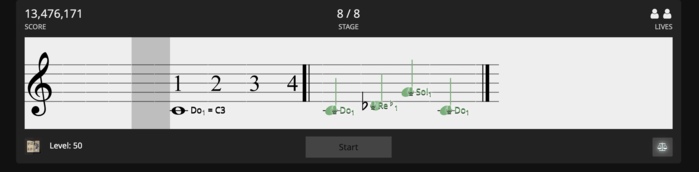
@Petr Hartmann according to TG support they use the fixed system, not the moveable one. They said The labeling in the image is based on the fixed-do solfège system where musical notes are labeled in Latin. Do, Re, Mi, Fa, Sol, La and Si.
To push back on value. These games, overall, have massively improved my ear. There are some shortcomings but, at least for me, they are nothing compared to the benefits. I don't know of a better alternative for all-around ear training.
I can't say I notice much of a difference, but the fact I'm progressing through the games must mean something. I just wish they'd explain things about the games. Surely it would be helpful to know from the start that they use a fixed-do system for Solfègiator? Are we supposed to just know these things?
@Adam Deering @Scott Slotnick it's a complex topic and the point of view depends on a variety of factors.
1. i think some exercises are more useful than others. sometimes that's due to the nature of the exercise, but most of the time it's just because a particular exercise designed or has better content.
solfegiator, melody jay, melodix and (to some degree) melody hunter don't use any melodies that put notes in musical context. solfegiator is particularly bad in that regard, because it doesn't even walk us through arpeggios and goes straight to random combinations of notes from the major scale and then progresses to locrian with a lot of sharps or flats. i wouldn't spend too much time on these.
i find interval exercises here, like intervalis, departurer, lander and calibrator, to be the most useful ones, they train very basic skills, necessary to hear what's going on in tunes. interval barks is also another crucial one.
rhythmic exercises are OK. rhythmic parrot offers nonsensical rhythms at times, and rhythmania contains a ton of mistakes that never seem to be fixed, but overall these are useful.
chordelius is OK too, but interval exercises are a pre-requisite.
inversionalist is somewhat useless, as it goes into the weeds at higher levels and doesn't spend much time on revisiting more basic inversions, so you tend to forget what those sound like. you'd have to use separate apps to practice this in a more focused way. my favorite lately is politonus, it combines functional training with understanding chord composition harmonically.
Route VI is good in theory, but there are many tricks to get the answer right, which will not get you any closer to hearing it in real life. in general, with a lot of exercises there is a way to pass levels without actually getting better at them. i think chordcrush got the chord progression training right in comparison
2. i think there is a certain point after which getting better at exercises offered here doesn't really bring any additional value when it comes to using these tools in practice. what this website does though is give you a minimal set of tools to start transcribing. i honestly can't tell if i got better at exercises here because i was doing daily workouts or because i was doing *something else*. coincidentally, i felt like i performed much better at workouts here after transcribing a complex piece of music, leveling up pretty fast. i also trained specific skills in separate apps, because workouts here weren't focused enough.
long story short, i think workouts here give you something your brain can latch on, a minimal set of tools to work with. they also provide a very vague indicator of the overall aural skills development. but to see any results in practice, i strongly believe one should spend more time on transcribing and less time on doing workouts here, especially past a certain level and once you can actually do that type of work more or less comfortably away from the instrument (not guess notes)
Incidentally, I'm quite good at the interval games and not so good at the ones you suggest aren't well designed. I'm wondering if I should just spend my limited time practicing and learning songs on my keyboard instead of spending it on the games here. I find that a lot of the time the games here just raise more questions for me, and since TG don't bother providing instructions or explanations, it doesn't make learning easy.
I agree with you about the Route VI game. I don't think I'm learning much from it. Most of my answers involve some guesswork. I'm not really recognising the chord progressions. If the multiple choice answers were taken away, I'd probably never progress through the levels.
I will check out chord crush and politonus. Thank you for the suggestions.
Discuss everything regarding music, composing and hot coffee. Recommend videos and courses from the learning center. Get inspired and inspire others to make great music.
We use cookies to improve your experience. Essential cookies keep the site running. We also use optional cookies to enhance performance, analyze traffic, and personalize ads. By clicking “Accept”, you agree to the use of all cookies.


Feb 12, 2024
Feb 12, 2024
Feb 12, 2024
Feb 12, 2024
Feb 12, 2024
Feb 12, 2024
Feb 12, 2024
Feb 13, 2024
Feb 13, 2024
Feb 13, 2024
Feb 13, 2024
Feb 13, 2024
Feb 13, 2024
Feb 14, 2024
Feb 14, 2024
Feb 14, 2024
Feb 14, 2024