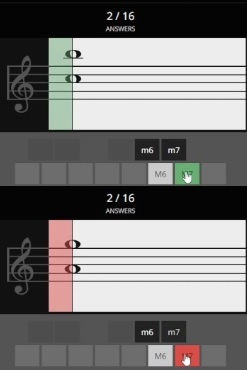
Please can somebody explain this to me? 😅 I get why a harmonic interval with ♭ note is minor and with ♯ note is major. But why without accidental it is sometime minor and other time major? To me it looks like the same interval.
Hi Peter, I agree it looks the same but there is a difference. You can also look it this way: the upper interval is c-b and b is a semitone below the octave (b is a semitone lower than c) so that makes a M7. The lower interval is a -g and g is a whole tone below the octave (g is a whole tone lower than a) so that make a M7.
Hi Caspar, thank you so much! It makes sense now, I should have played it on piano before posting. So in the time limit you have to analyze both notes and determine how many semitones are between them. That seems incredibly hard 😅.
Hi, you can think of a piano keyboard and count the semitones starting from the lower tone. So you have the following (starting e.g., from a C) C-C#/Db - m2 C-D - M2 C-D#/Eb - m3 C-E - M3 C-F - Perfect 4th C-F#/Gb - Tritone C-G - Perfect 5th C-G#/Ab - m6 C-A - M6 C-A#/Bb - m7 C-B - M7 C-C - Perfect Octave
Thanks everyone for the tips. So for example if the bottom note is C, I am certain that every interval with natural note will be Major. But if bottom note is D; D-F will be minor 3rd and D-C will be minor 7th? And I need to learn these relations for each tone? That seems like such a chore 😅.
Every interval can be inverted with the same notes, right?
Imagine that you have a C and a D.
The C is the lower note on this example, and D is the higher. (Let's consider the span of one octave only)
Because of the familiarity you already have with music you know that from C to D we have a major 2nd, because of two things: the order of the notes and the numbers of semitones between them.
If we count from C, then C is 1, and D is 2. So the interval is of a 2nd. And since there are two semitones between those notes, it is a major 2nd.
Cool, now let's invert this interval:
We put D as the lower note and C as the higher.
Let's count which interval is it:
D is 1, E is 2, F is 3, G is 4, A is 5, B is 6, and C is 7.
Therefore, from the order of the notes we already know here that the interval between D and C is a 7th.
Now, to count each semitone between D and C, so we can know if that 7th is minor or major, can be boring and disturb our flow and mindset, right?
So now comes the cool part:
EVERY major interval, when inverted, becomes a minor interval; and, obviously, EVERY minor interval, when inverted, becomes a major interval.
If you are already familiar that from C to E there is an interval of a major 3rd, rest assured that from E to C there will be a minor 6th.
And you don't need to count (E is 1, F is 2, G is 3, A is 4, B is 5, C is 6) in order to know that the interval between an E and a C is a 6th.
Here comes the next cool part:
EVERY interval and its invertion, sums the number 9.
C to D is a 2nd, right? Wanna know what interval there is from D to C? Just subtracts 9 - 2 and there it is: 7.
C to E is a major 3rd. 9 - 3 = 6. Then, the interval between E and C is a minor 6th.
From your screenshot, you can quickly tell that from A to G there is a minor 7th, if you know that from G to A there is major 2nd.
Now, as EVERY major interval, when inverted, becomes a minor interval; and EVERY minor interval, when inverted, becomes a major interval... a perfect interval, when inverted, is ALSO a perfect interval:
I know that from C to F there is a perfect 4th. What about F to C? 9 - 4 = 5.
@igor reis I really appreciate the effort you put into your reply! All 'cool parts' were kind of revelation to me 😅. I knew there will be some more clever approach than just memorizing everything. It blows my mind how a lot of music theory is just math, patterns and combinations.
So to sum it up I still need to improve my sight-reading by a lot - to be able to identify both notes as fast as possible. But for example if I get E - G, within one octave it can form either minor 3rd or Major 6th - quick check 9-3=6. Got it.
''But for example, if I get E - G, within one octave it can form either minor 3rd or Major 6th - quick check 9-3=6. Got it.''
Maybe you got it right, but as I'm not sure, I would like to approach this again from another perspective.
I chose the span of an octave because I used C as our starting point, and we all started learning music with the C major scale for historical, and practical reasons (the visualization of the keyboard). I could give the examples in an octave starting from any note, like A3 to A4, F1 to F2...
If I have two notes and want to know which interval is between them, I must know which note is the lower and which is the higher.
Inside the span of ONE OCTAVE from C to C, we have the interval of E to G. This interval is of a minor 3rd, whether the octave is ASCENDING (where we will see the E appearing first and G after) from, let's say, C2 to C3, OR DESCENDING from C3 to C2 (where we will see the G appearing first and the E after) on the direction of our motion.
But we can't have the G as the lower note and ascend to an E above it without spanning our scale.
C - E - F - G - A - B - C - D - E ...
You are right when you said that E to G can be a major 6th, BUT then it is implied that G is the lower note, E is the higher and, therefore, we are departing from E to G on a DESCENDING motion.
If we depart on an ascending motion from E, as the lower note, to G, as the higher, it is a minor 3rd.
I will give some more tips that I think will be useful.
1) If we don't restrict our analysis to one octave and I ask you: Petr, which interval is between C3 and D4?
Easy. You know that from C to D (C as the lower note, the reason why I put it as first is because it matches the direction from which we read with the direction of lower notes of a keyboard to its higher ones) there is a major 2nd.
All you have to do is to add the number 7.
So, from C to D there is a 2nd. But I want to know the interval between C and the D on the next octave.
Just make the math: 2 + 7 = 9. The interval is of a 9th. The QUALITY of the interval remains the same.
So, a MAJOR 2nd + 7 = it's a MAJOR 9th. This is the interval from C3 to D4.
C3 to A4? From C to A there is a major 6th. 6 + 7 = 13. Therefore the interval between C3 and A4 is a major 13th.
And so on...
2) I mentioned major, minor, and perfect intervals, but, obviously, these same numeric relations and simple equations are applied to the relation between augmented and diminished intervals.
Let's try it out.
What is the interval between C and F#?
To count the interval we can, and shall, ignore sharps and flats. In this case is convenient that we see sharps and flats really as an ALTERATION of a NOTE, despite F and F# being different PITCHES.
C is 1, D is 2, E is 3, F is 4. Thus, from C to F there is a 4th.
Now, this F being natural, with no alteration, the 4th between C and F is a perfect 4th. But we want to know the interval between C and F#. Therefore the interval is not a perfect 4th, but an AUGMENTED 4th.
Let's go to the next step: Which interval is between F# (the lower note from which we are departing) to C?
Since we already know that EVERY interval and its inversion sums the number 9...
9 - 4 = 5.
Since the 4th we are considering here is an augmented 4th, then this 5th IS a diminished 5th.
So the rule is:
EVERY augmented interval, when inverted, becomes a diminished interval; and, obviously, EVERY diminished interval, when inverted, becomes an augmented interval.
3) Let's now consider looking at a score.
The staff is made of 5 lines. Drawing these 5 lines we also get 4 spaces. Notes can be written upon a line or inside a space, right?
Rest assured:
IF two notes are separated by the SAME TYPE of location in a staff (whether both notes occupy lines or both notes occupy spaces), the interval between them will ALWAYS be of an odd number... 1 (unison), 3rd, 5th, 7th, etc...
IF two notes are separated by DIFFERENT TYPES of location in a staff (one note occupying a line and the other note occupying a space), the interval between them will ALWAYS be of an even number... 2nd, 4th, 6th, octave etc...
You can check for yourself!
With all these basic approaches, soon enough you will find yourself knowing the interval between two notes, and its quality, on the first glimpse. You won't need to think ''I'm going UPWARDS from E to C, which interval is it? Well, C to E is a major 3rd. 9 - 3 = 6. Then the interval between a lower E to a higher C is of a minor 6th.''
It will become natural knowing that going up from E to C we have a minor 6th.
If there are any doubts or if there is anything else I can help with, let me know!
I once heard a great mathematics teacher stating something about mathematics that can be applied to music:
@igor reis thanks again 👍! I really appreciate when skilled and wise take their time to properly explain something. And you really went an extra mile! I think I understand everything, but I will keep going back to your posts - it is a lot to digest.
@igor reis : at this moment, I'm standing in front of my screen clapping my hands as a sign of respect for your explanations, past, recent and future. If you can picture that, you'll be able to see how big of a fan is speaking right now. My cat is a bit scared about the scene, but he'll be ok soon. 🙏
Like your cat, I'm also scared that you can clap and type at the same time! 😂 Just kidding! Wow! Thank you, Cuantas! I much appreciate it! In my social circle, I don't have anyone to talk to about music, so it is really a pleasure to put some things out. I hope your cat is already fine by now!
2 props
We use cookies to improve your experience. Essential cookies keep the site running. We also use optional cookies to enhance performance, analyze traffic, and personalize ads. By clicking “Accept”, you agree to the use of all cookies.


Mar 20, 2024
Mar 20, 2024
Mar 20, 2024
Mar 21, 2024
Mar 22, 2024
Mar 22, 2024
Mar 24, 2024
Mar 24, 2024
Mar 24, 2024
Mar 25, 2024
Mar 25, 2024
Mar 26, 2024
Mar 26, 2024