If you don't get the name of the reference note at the beginning, you're just singing pitches relative to the initial sound by applying the interval info presented, so there's no use in looking for the 'right note name to sing'... Use the syllable that you feel more comfortable singing within your range and it will be fine.
Just so you have a direct answer to your question, any pitches outside the major-scale solfège pattern have different names depending on whether they are seen as sharp or flat.
In other words, the same non-major-scale pitch will have a different solfège name if it's going up (and therefore perceived as sharp) or if it's going down (and therefore perceived as flat) even though it's the same note.
You can find all the names in a Tonegym article about Solfege. Go to the 'blog' section and find the solfège article. There's a diagram with the different names for the pitches ascending and descending.
@Neil Gilmartin thanks. I read that article, but it confused me. The first notation has the regular Do, Re Me etc, which is fine, but then in the second one Te becomes Si for some reason. I will read it again and see if I can make sense of it.
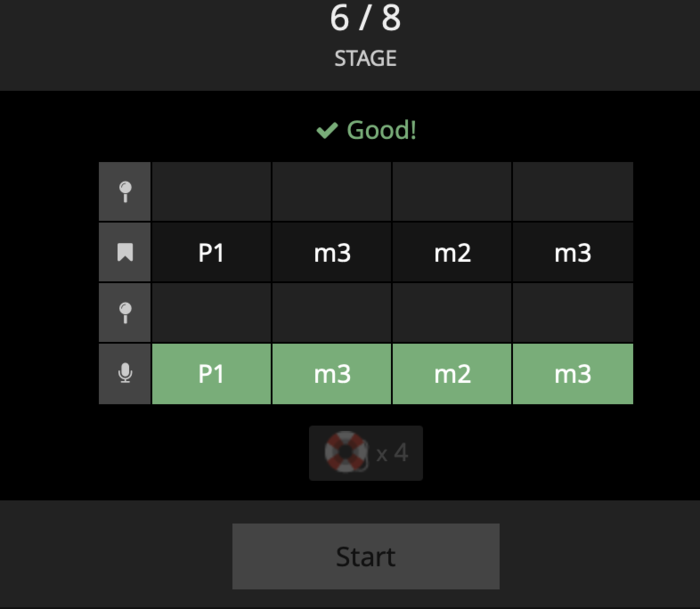
Also, if someone said 'sing a m2 interval', would that be sung Di or Rah?
A m2, related to C, is Db, therefore would be Ra. A C# is not a m2, but an augmented 1. They can sound the same, but on broader aspects of music, they are certainly different.
The 1, m2, m3 sequence can be related to the beggining of the locrian and phrygian modes, and we will find the same intervals if we sing the following degrees of the C major scale: E (M3), F (P4) and G (P5).
In that diagram you posted, the first diagram does NOT have the regular Do-Re-Mi. The spelling of the regular one is Do-Re-Mi-Fa-Sol-La-Ti-Do (no Me or Te)
And I'm pretty sure that final syllable in the 12-note illustration you posted is just a typo and should actually read 'Ti' not 'Si''?
To answer your question, if someone is singing a minor second going up, I guess they would sing 'Rah' (because the second note is a flat, not a natural). If they were singing a raised first (the same note, but seen in a different context) they would sing 'Di'.
The diagram below seems more useful to me for understanding the naming than the one you posted earlier, as it shows the names going up and going down. You can see the regular major scale names (Do-Re-Mi-Fa-Sol-La-Ti-Do) in there among the outside notes too.
@Neil Gilmartin that screenshot is from the solfège article on TG. I think you can understand now why myself and others get so confused while trying to learn this when the stuff we are learning from is incorrect/inaccurate.
Also, as others have said - with this game (Melody Jay) - it’s not clear where “Do” is. If it is moveable Do, where is the Tonic? I think the main object of this game is just to sing the melody back accurately, not apply solfège syllables to it.
@Ken Wilkens thanks. That's what I've been doing up to now, but thought it'd be a good opportunity to practice my solfège so I could learn what notes and intervals I was singing. I'm very good at singing the tunes back correctly, but I don't always know what intervals or notes I have sung until the game shows me. I though that using solfège might help with that.
As Igor explained above, it says it's a m2 and not an augmented 1, so that would be Ra, which is what I was trying to get my head around originally. If I'm going to use solfège, I'd just like to make sure I'm using it correctly.
Adam, I thought I'd posted an image in my last post but turns out I hadn't. You might have been confused when I said 'the diagram below seems more useful to me'. I was referring to the one which now - really is - directly below :-)
2 props
Space Description
Discuss everything regarding music, composing and hot coffee. Recommend videos and courses from the learning center. Get inspired and inspire others to make great music.
We use cookies to improve your experience. Essential cookies keep the site running. We also use optional cookies to enhance performance, analyze traffic, and personalize ads. By clicking “Accept”, you agree to the use of all cookies.


Jul 29, 2023
Jul 30, 2023
Jul 31, 2023
Jul 31, 2023
Jul 31, 2023
Jul 31, 2023
Jul 31, 2023
Jul 31, 2023
Aug 01, 2023
Aug 01, 2023
Aug 01, 2023
Aug 01, 2023
Aug 03, 2023