I know I'm repeating myself, but I wanted to bring attention to how dreadful solfegiator is at higher levels. This has been the pattern for the last 30 levels or so (70-100), where it just picks random sharp notes. I find these of very little use to developing musicianship. ToneGym team, is there any way you could have it go through something more musical? Chord arpeggiations, melodies, other keys (minor at the minimum).
+1 for this maybe also different rhythms, longer phrases, etc. but in (varying) major and minor scales would be more helpful before introducing out of scale sharps and flats ..
I think there's a different manner we can approach this in a way it becomes more useful for us.
What I try to do is relating the notes the game brings to particular fragments of a natural major or minor mode.
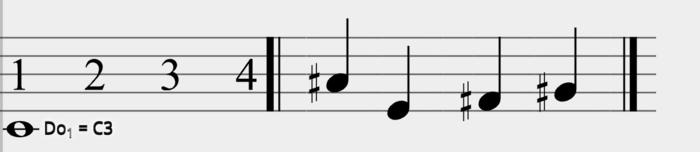
On the example you brought we don't have F#, G# and A# on the major scale of C. So, taking C as the reference is not the best at all.
But the relation between all the notes presented (E, F#, G# and A# - whole step, whole step, whole step), is the same we find on the scale of C from the 4th degree to the 7th: F-G-A-B.
E-F#-G#-A# would be 4th, 5th, 6th and 7th steps of B.
But trying to hold a B in your head after the game plays a C is a mess. The minor 2nd would pull you easily towards the C.
What I would do is not singing the solfege note names accordingly to the sheet, but where is A# I would sing B, where is E I would sing F and so forth... Then it would makes sense in the context of a natural major mode.
@igor dinotte that's honestly how i have been going through these exercises, which feels like cheating, but there is just no other way around it at the moment, as i'm not interested in learning to sing locrian. i keep doing that in hopes that the meaty levels of this exercise are hiding somewhere after this 😅
1 props
Space Description
Discuss everything regarding music, composing and hot coffee. Recommend videos and courses from the learning center. Get inspired and inspire others to make great music.
We use cookies to improve your experience. Essential cookies keep the site running. We also use optional cookies to enhance performance, analyze traffic, and personalize ads. By clicking “Accept”, you agree to the use of all cookies.


Nov 29, 2023
Nov 29, 2023
Nov 29, 2023